Lissaire guide
Can you iron polyester, linen, silk or wool? A fabric guide
A fabric-by-fabric guide to ironing polyester, linen, silk, wool, cotton and more. It shows the heat for each fabric, when a steamer helps, and how to read a care label.

By Hana, co-founder of Lissaire
Updated · 8 min read
On this page
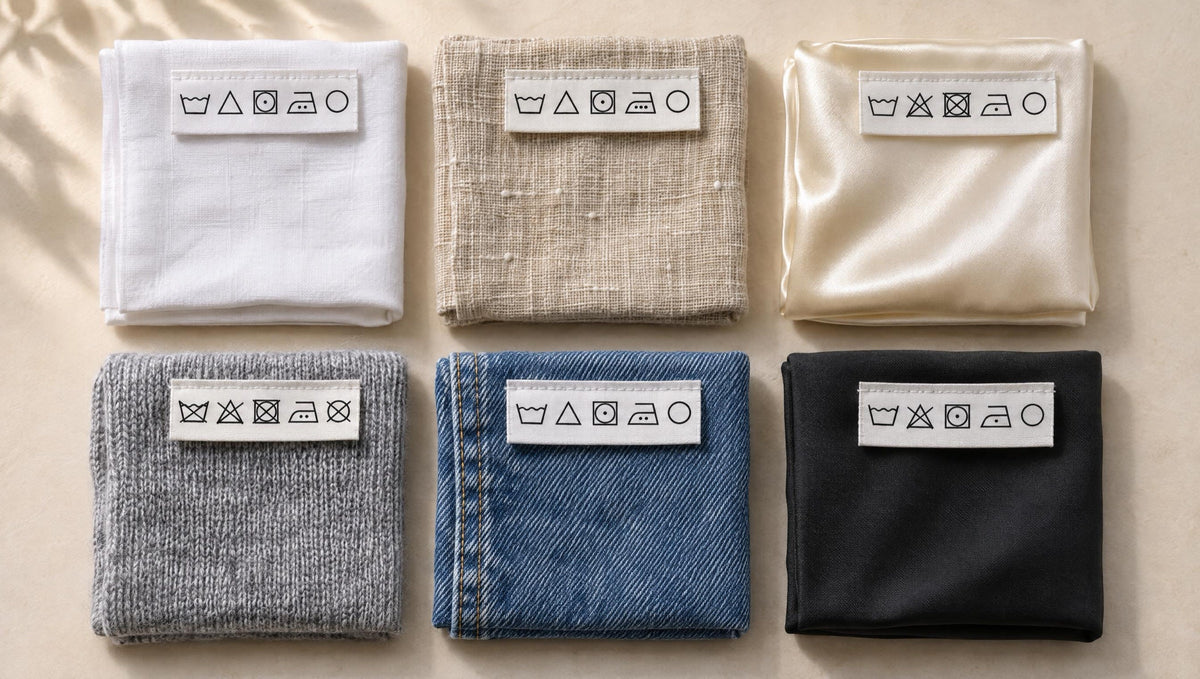
Yes, you can iron polyester, but only on low heat, because high heat can melt it. Cotton and linen take high heat, and polyester, nylon and silk need low heat. Always check the care label (the small tag sewn inside the clothes) first, because its dots show the right heat.
Key takeaways
- You can iron polyester on low heat, inside out, with the iron always moving.
- On a care label's iron symbol, 1 dot means low heat, 2 dots medium heat and 3 dots high heat.
- Wool needs low to medium heat and a pressing cloth, and suits and thick coats should go to the dry cleaner.
- The Lissaire Automatic Ironing Machine uses 122°F for silk, polyester, rayon and nylon, 140°F for everyday shirts and 167°F for thick cotton.
How do you read the ironing symbols on a care label?
The ironing symbol on a care label looks like a small iron. The dots inside it show how much heat to use. An iron with an X over it means do not iron.
| Symbol on the care label | What it means |
|---|---|
| Iron with 1 dot | Low heat |
| Iron with 2 dots | Medium heat |
| Iron with 3 dots | High heat |
| Iron with an X over it | Do not iron |
| Iron with crossed-out lines under it | Do not use steam |
Many irons have the same dots on the dial.
If the label has no ironing symbol, or the label is gone, start with low heat. Then test the iron on a hidden spot, such as the inside of a hem (the folded edge at the bottom). If the wrinkles stay, raise the heat one step and test again.
Lissaire tip: The same rule works on the Lissaire machine. If you are not sure, start with less heat. The lowest heat on the machine is 122°F.
A pressing cloth is a thin, clean cotton cloth, such as a cotton dish towel. You lay it between the iron and your clothes, so the iron does not touch the fabric. Use one for silk, wool and cashmere. It also helps with polyester and dark linen.
If you have no iron with you, see How to get wrinkles out of clothes without an iron.
Can you iron polyester?
Yes. Iron polyester on low heat. High heat can melt it or make it shiny.
- Check the care label for the dots.
- Set the iron to low heat.
- Turn the clothes inside out.
- Lay a pressing cloth on top if you have one.
- Keep the iron moving. Do not leave it in one spot.
You can also use a clothes steamer on polyester. Check the care label first.
Can you iron linen?
Yes. Linen takes high heat, and it irons best while it is damp (a little wet).
- Check the care label for the dots.
- Iron the linen while it is still damp from the washer. If it is dry, spray it with water first.
- For dark linen, turn it inside out or use a pressing cloth. Both help stop shiny marks.
- Hang it at once after you iron it.
Linen wrinkles easily, so it will get some new wrinkles when you wear it. That is normal for linen.
Lissaire tip: Put linen and cotton shirts on the Lissaire machine while they are still damp from the washer, but not dripping. Dry clothes keep their wrinkles.
Can you iron silk?
Yes, but only on low heat. Turn silk inside out, and use a pressing cloth.
- Check the care label. Some silk labels say "dry clean only". If yours does, take it to the dry cleaner.
- Set the iron to low heat. Many irons mark this setting "silk".
- Turn the silk inside out. Lay a pressing cloth on top.
- Press gently, and keep the iron moving.
- Do not spray water right on silk, because water can leave spots on some silk.
Rowenta and Reader's Digest say a steamer is also good for delicate fabrics, such as silk.
Can you iron wool?
Yes, but be careful. Use low to medium heat (the wool setting on many irons), and always use a pressing cloth. Without a cloth, the iron can leave shiny marks on wool.
- Check the care label. Many wool labels say "dry clean".
- Set the iron to the wool setting, or to low to medium heat.
- Lay a damp pressing cloth on the wool.
- Press the iron down, lift it, and move it to the next spot. Do not slide it back and forth.
- Hang the wool clothes and let them cool and dry.
Rowenta and Reader's Digest say a steamer is also good for knits, such as wool sweaters.
What about cotton, denim, blends, rayon, nylon and cashmere?
- Cotton: use high heat. Cotton irons best while it is still damp.
- Denim (jeans): use high heat, as for cotton. Turn jeans inside out. If the label lists spandex, use less heat.
- Blends: a blend is cloth made from two or more kinds of thread, such as cotton and polyester. Follow the dots on the label. If there is no label, use the heat for the thread that needs the least heat.
- Rayon (also called viscose): use low heat, and turn it inside out. Test a hidden spot first. Some rayon labels say "dry clean only".
- Nylon: use low heat. High heat can melt nylon.
- Cashmere: use low heat with a pressing cloth, but only if the label allows ironing. A steamer is another choice.
- Leather and suede: do not iron them. Follow the care label.
Which fabrics can you iron? The full table
Most fabrics in this table can be ironed at the right heat. Leather cannot. These heat levels are general care advice, so the care label on your clothes comes first. The last column is for the Lissaire machine, which we sell.
| Fabric | Iron heat | Clothes steamer | Lissaire machine |
|---|---|---|---|
| Cotton | High, while damp | Yes, but it cannot press sharp creases (sharp folds) | Yes. 140°F for everyday shirts, 167°F for thick cotton |
| Linen | High, while damp | Yes, but it cannot press sharp creases | Yes. 140°F for everyday shirts, 122°F for thin, light ones |
| Polyester | Low, inside out | Yes | Yes, at the lowest heat, 122°F |
| Cotton and polyester blends | Follow the label's dots | Yes | Yes. 140°F for everyday shirts |
| Silk | Low, inside out, with a pressing cloth | Yes, good for delicate fabrics | Yes, at the lowest heat, 122°F |
| Rayon (viscose) | Low, inside out | Yes | Yes, at the lowest heat, 122°F |
| Wool | Low to medium, with a pressing cloth | Yes, good for knits | No. The owner's manual says not to press wool |
| Cashmere | Low, with a pressing cloth | Yes, good for knits | Yes, at the lowest heat, 122°F |
| Denim | High, inside out | Yes, but an iron is best for heavy fabrics | Yes, on the pants and jeans attachment (the part of the machine the jeans go on), at 167°F |
| Nylon | Low | Yes | Yes, at the lowest heat, 122°F |
| Leather | Do not iron | No | No |
The steamer notes on delicate fabrics, knits and sharp creases come from Rowenta and Reader's Digest. The note on heavy fabrics comes from Gentleman's Gazette.
Which fabrics work on the Lissaire machine?
Cotton, linen, blends, silk, cashmere, polyester, rayon and nylon work on the Lissaire machine, each at its own heat. Leather, suits, thick coats and sizes larger than XXL do not. This section is about our own product. Lissaire is a company founded by Hana and Ed. It sells the Lissaire Automatic Ironing Machine.
The machine dries and irons in one step. You pull a damp shirt down over the shirt attachment, the part of the machine your shirt goes on. Warm air fills the attachment. The attachment then holds the shirt smooth and gently pulled while it dries. Cloth keeps the shape it has when it dries, so the shirt dries smooth. When the timer ends, it is ready to wear.
- Your hands are free. Each piece of clothing takes about 8 to 12 minutes, so you can make coffee or read.
- More than shirts. The machine also works on blouses, polo shirts and T-shirts. Other attachments let it iron pants, jeans and dresses.
Use 122°F for silk, polyester, rayon and nylon, for other thin and light clothes, and for light jackets. Cotton, blend and cashmere sweaters also use 122°F, unless the care label says to dry flat. Use 140°F for everyday shirts and 167°F for thick cotton, such as jeans. The machine's owner's manual says not to press wool, so do not put wool on it.
What it cannot do: it does one piece of clothing at a time, and an iron can be faster, even for one shirt. It cannot make a sharp fold down the sleeves, so use your iron for that. Keep children away, because the base and the two rods that stand in it get hot.
See how the Lissaire machine works
Which fabrics should always go to the dry cleaner?
Clothes whose care label says "dry clean only" should go to the dry cleaner. So should suits, suit jackets and thick coats, whatever fabric they are made of. If you are not sure, ask the dry cleaner before you wash or iron the clothes.
Labels on wool, silk, rayon, cashmere and leather clothes may say "dry clean". Check those labels closely.
Look for a washing symbol on the label. It looks like a small tub of water. Everyday shirts, blouses and pants with this symbol can usually be washed at home. To learn how, see How to wash and iron dress shirts at home. After you wash them, the Lissaire machine can dry and iron them, so they do not need the dry cleaner.
Quick answers
Will polyester melt if you iron it?
It can, on high heat. Iron polyester on low heat, turn it inside out, and keep the iron moving.
Is it better to iron linen damp or dry?
Damp. Linen irons best while it is a little wet, on high heat. If it is dry, spray it with water first.
Can you put silk on high heat?
No. Iron silk on low heat, inside out, with a pressing cloth. Some silk labels say "dry clean only", so check the label first.
Can you iron wool without a pressing cloth?
It is better not to. The iron can leave shiny marks on wool. Use a damp pressing cloth and the wool setting on your iron.
What does an iron with an X on a care label mean?
It means do not iron these clothes. Follow the rest of the care label.
Can you put polyester on the Lissaire machine?
Yes. Use the lowest heat, 122°F. The same goes for rayon and nylon. Check the care label first.
What heat does the Lissaire machine use for silk?
It uses the lowest heat, 122°F. Check the care label first.

More guides
-

11 min read
How to get wrinkles out of shirts: 7 ways and how each works
Shower steam, a wet towel in the dryer, a spray for wrinkles: how each way works, and what people say about it. Way 7 is the...
Read the guide -

11 min read
Is an ironing machine a good Christmas gift? 4 yes, 1 no
4 people on your Christmas list who would use an ironing machine, and 1 who would not. Start with how they make their shirts smooth now.
Read the guide -

9 min read
Cost to dry clean shirts: one year, at your own price
$3 a shirt, 5 shirts a week is $780 a year at the dry cleaner. Put in your own price and see your year, plus 7...
Read the guide